

The tiles price in Nepal run from about NPR 40 per sq ft for basic ceramic to over NPR 700 for porcelain and designer ranges, and most homes land between NPR 175 and 260 for good vitrified tiles. Rates depend on type, size, finish and brand, so use the dated tables below and confirm with your dealer.
Last updated: 19 November 2026. Rates are compiled from published manufacturer and dealer price lists from March to November 2026. They are indicative; they do not include installation, and they are not a quotation.
Tile price per sq ft in Nepal: current rates
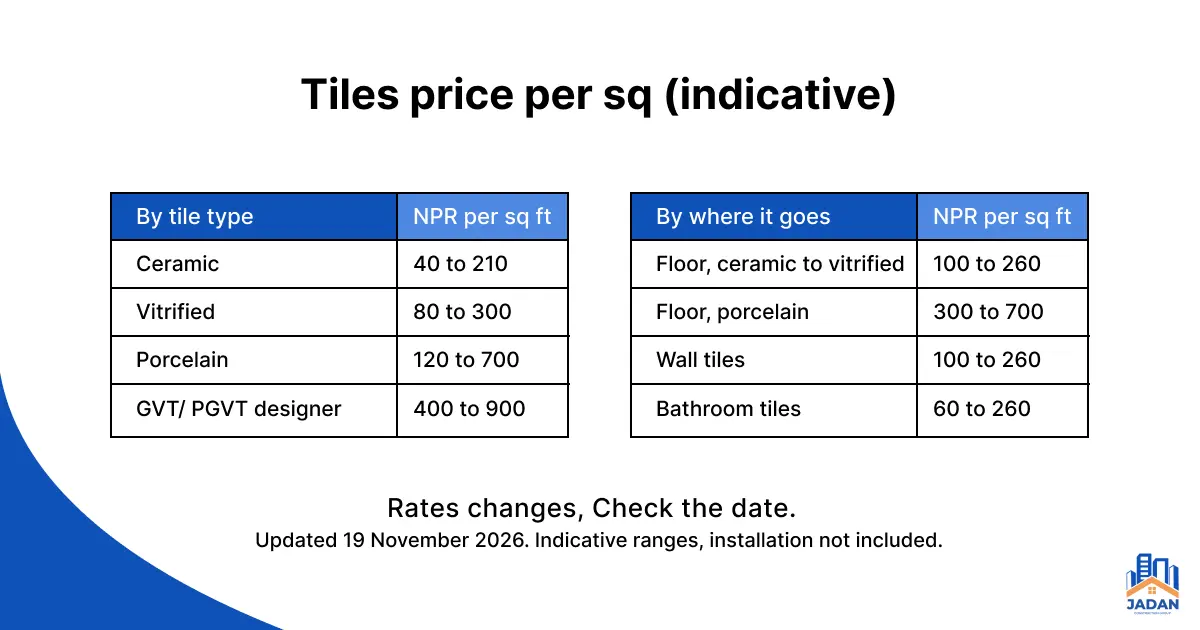
The first table shows the market range for each tile type. The low end is basic local or budget tile, and the high end is branded or designer ranges. Published sources quote slightly different ranges, so the figures below cover the full span they report.
|
Tile type |
Price (NPR per sq ft) |
Typical use |
|
Ceramic |
40 to 210 |
Walls, bathrooms, bedrooms |
|
Vitrified |
80 to 300 |
Living rooms, kitchens, corridors |
|
GVT and PGVT designer |
400 to 900 |
Feature floors, lobbies, showrooms |
|
Porcelain |
120 to 700 |
Wet areas, terraces, heavy traffic |
|
Marble-finish ceramic or porcelain |
195 to 500 |
Living rooms, feature areas |
The second table shows the same market by where the tile goes in your house.
|
Where you use it |
Price (NPR per sq ft) |
|
Floor tiles, ceramic to vitrified |
100 to 260 |
|
Floor tiles, porcelain |
300 to 700 |
|
Wall tiles, basic to designer |
100 to 260 |
|
Kitchen wall tiles, basic and digital |
72 to 200 |
|
Bathroom tiles, ceramic to vitrified |
60 to 260 |
|
Anti-skid bathroom floor tiles, ceramic |
60 to 200 |
|
Anti-skid bathroom floor tiles, porcelain |
300 to 500 |
Rates change with the market, and the same tile can differ by 10 to 20 percent between dealers. Get at least three quotes and ask for the current price in writing.
What decides the price of tiles in Nepal
Two tiles that look alike on a shelf can sit far apart on price. These are the things that move the number.
Type of tile. Ceramic tiles have a clay body with a glazed surface. Vitrified tiles are fired to a much denser body, so they absorb very little water and take heavy foot traffic better. Porcelain is denser still and is usually the premium choice. Denser tiles cost more to make, and the price shows it.
Size. A 2x4 ft tile costs more per square foot than a 1x1 ft tile of the same series, and large tiles also need more skilled fitting. The size you pick changes the labour bill as well as the material bill.
Finish. Glossy, matt, satin, wood-look, stone-look and anti-skid finishes are all priced differently. Digital printing and polished surfaces usually sit at the higher end.
Brand and series. A well-known brand with a wide dealer network and a warranty will normally ask for more than an unbranded tile. Within one brand, newer or designer series cost more than the basic range. Many tiles sold in Nepal are imported, mostly from India and China, and there are Nepali manufacturers too, so the same-looking tile can arrive through very different supply routes.
Quality grade and shade. Tiles from the same factory come in grades. A first-grade box costs more than a second-grade one, and a cheap rate sometimes means a lower grade. Always ask which grade you are being quoted.
Transport and handling. Tiles are heavy and break easily. Delivery to a hill site, a narrow street or an upper floor can add to the final cost.
Ceramic vs vitrified vs porcelain: what you actually get
Ceramic is the budget-friendly option and works well on walls and in low-traffic rooms such as bedrooms. It is not the best pick for a busy kitchen floor or an outdoor area because it can chip and wear faster.
Vitrified tiles are the most common choice for living rooms, corridors and kitchens in new Nepali homes. They resist stains and scratches well and are easy to keep clean. If you want one tile type to cover most of the house, this is usually it.
Porcelain suits owners who want the lowest water absorption and the longest life, for example in a bathroom, a terrace or a high-traffic entrance. You pay more upfront, and in return you should not need to think about replacing it for a long time.
If you are still deciding which tile suits which room, our guide on the best tiles in Nepal walks through that choice. This page stays focused on what the tiles cost.
Tiles price in Nepal by brand
Kajaria Ramesh tiles are made in Nepal through a joint venture between Ramesh Corp and Kajaria Ceramics, with a factory in Bhairahawa. Its own price list, published in March 2026, is below. Retail discounts may apply depending on the dealer and location.
|
Size |
Tile type |
Price (NPR per sq ft) |
|
60x120 cm |
Polished GVT |
230 |
|
60x120 cm |
Carving GVT |
240 |
|
19.5x120 cm |
Matt GVT |
260 |
|
60x60 cm |
Polished |
200 |
|
60x60 cm |
HD polished |
210 |
|
60x60 cm |
Matt or wood finish |
220 |
|
40x40 cm |
Matt GVT (8 mm) |
160 |
|
40x40 cm |
Heavy duty |
260 |
|
30x60 cm |
Digital ceramic |
200 |
|
30x45 cm |
Digital wall tile |
175 |
|
30x30 cm |
Digital matching |
150 |
Other brands sit at different points. RAK Ceramics, imported from the UAE, generally starts from about NPR 300 and passes NPR 700 for designer collections. Somany, an Indian brand sold through authorised dealers, averages around NPR 160. Locally made tiles can start as low as NPR 100 to 105, which suits utility areas and budget projects, though you should check thickness and water absorption before buying in bulk.
Floor tiles price in Nepal
Floor tiles are the biggest part of your tile budget because they cover the most area. For living rooms and bedrooms, most people look at vitrified tiles in 2x2 ft or 2x4 ft sizes. For kitchens, pick a matt or lightly textured finish so spills and oil do not make the floor slippery. Planning a modular kitchen as well? Our modular kitchen design guide helps you decide the floor layout around the cabinets. For terraces, balconies and outdoor steps, choose anti-skid tiles rated for outdoor use, and expect to pay a little more than for an indoor tile of the same size.
When you compare floor tiles price in Nepal between dealers, compare per square foot and not per box. Boxes hold a different number of tiles depending on size, so a lower box price can hide a higher rate per square foot.
In rough numbers, branded vitrified floor tiles sit around NPR 200 to 260 per sq ft, and 60x60 cm (2x2 ft) vitrified tiles are commonly quoted between NPR 160 and 260 depending on finish. Basic ceramic floor tiles start near NPR 100, and porcelain floor tiles run from NPR 300 to 700. As a quick check, a 200 sq ft living room in vitrified tiles at NPR 230 per sq ft costs about NPR 46,000 for the tiles alone.
Bathroom and toilet tiles price in Nepal
Bathrooms need two different tiles. The floor needs a matt, anti-skid tile that grips when wet. The walls can use a glossy or satin wall tile, which is usually lighter, thinner and cheaper per square foot than a floor tile.
Bathroom tiles price in Nepal also depends on how high you take the wall tiles. Tiling to the ceiling costs more than tiling to a standard height, but it protects the wall from splashes and looks cleaner. In a toilet, small tiles on the floor help water run towards the drain, so the slope is easier to get right.
Branded bathroom tiles typically run NPR 150 to 200 for ceramic, NPR 175 to 210 for digital ceramic and NPR 210 to 260 for vitrified, while basic local ceramic starts as low as NPR 60. Most Nepali bathrooms use 30x30 cm or 30x45 cm tiles because they give better grip and drainage. One published estimate puts mid-range tiles for an average 40 to 60 sq ft bathroom at NPR 8,000 to 15,000, before fittings, waterproofing and labour.
Wet areas need proper waterproofing under the tiles. Good tiles laid on a poorly waterproofed floor will still leak. You can read more in our guide on waterproofing in building construction.
2x2 vs 2x4 tiles: size and price
Size is one of the first choices you make, and it changes how the finished floor looks and how much you pay for fitting.
|
Tile size |
Approx. size in cm |
Area per tile |
Where it works well |
|
1x1 ft |
30 x 30 |
1 sq ft |
Bathroom floors, small rooms, steps |
|
2x2 ft |
60 x 60 |
4 sq ft |
Bedrooms, living rooms, kitchens |
|
2x4 ft |
60 x 120 |
8 sq ft |
Large living areas, open plans, showrooms |
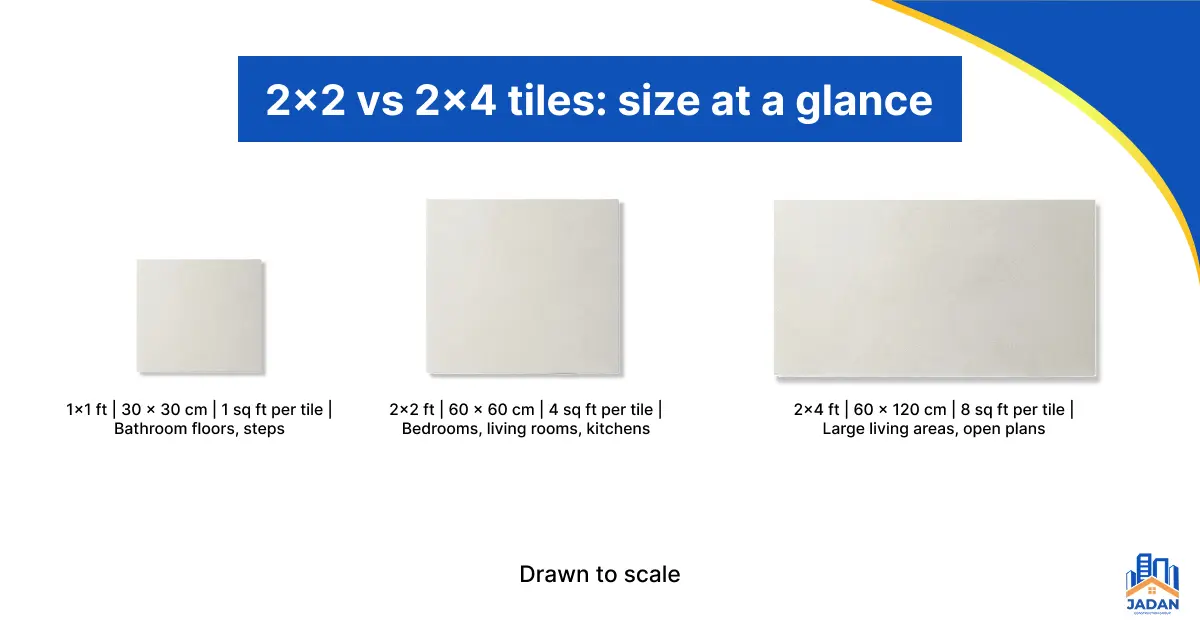
Larger tiles mean fewer joints, so the floor looks cleaner and is easier to mop. They also need a flatter base and more careful handling, because a long tile breaks more easily during carrying and cutting. If your rooms are small, a 2x4 tile can leave you with many awkward cuts and more waste, so a 2x2 is often the more sensible choice.
How many tiles do you need for a 1,000 sq ft house
You can work this out yourself before you speak to a dealer.
Start with the floor area you plan to tile. Add 10 percent for cutting and breakage as a safe default. Simple rectangular rooms can get by with 5 to 10 percent, while diagonal or pattern layouts need 15 to 20 percent. Then divide by the area of one tile.
Here is a worked example. Say you tile the full 1,000 sq ft floor and allow 10 percent for wastage.
|
Step |
Calculation |
Result |
|
Floor area |
|
1,000 sq ft |
|
Add 10% wastage |
1,000 x 1.10 |
1,100 sq ft |
|
Number of 2x2 tiles |
1,100 / 4 |
275 tiles |
|
Number of 2x4 tiles |
1,100 / 8 |
138 tiles (137.5 rounded up) |
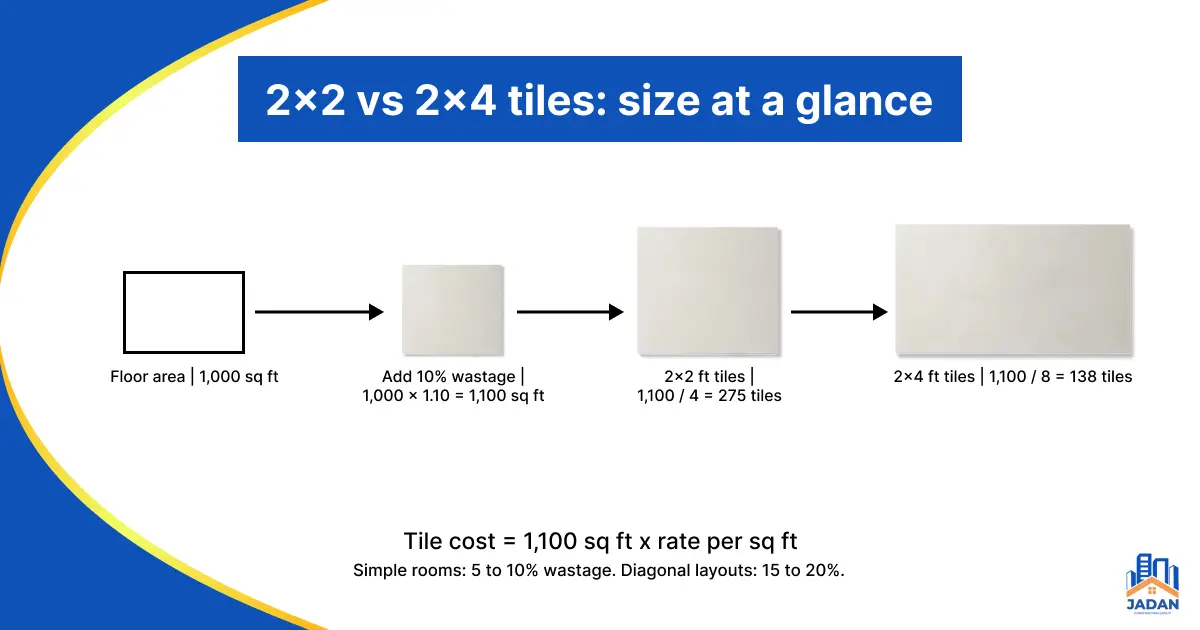
To estimate the tile cost, multiply 1,100 sq ft by the rate per square foot of the tile you chose. For example, vitrified tile at NPR 230 per sq ft comes to NPR 2,53,000 for the main floor. This only covers the main floor. Bathroom walls, kitchen counters, the staircase and the terrace need to be measured separately.
Costs that are not part of the tile rate
The rate on the tile is not the full cost of a finished floor. Plan for these as well.
Adhesive or cement mortar, grout, and spacers are needed for fitting. Labour is charged per square foot and usually goes up for large tiles, diagonal layouts and wall work. Skirting, cutting and edge finishing add up in rooms with many corners. Wet areas need waterproofing before any tile is laid. If your floor is uneven, it may need levelling first.
Installation rates differ a lot by source and by what is included. One guide quotes labour alone at NPR 25 to 60 per sq ft, with adhesive and grout adding NPR 15 to 30. Another quotes the full job, including mortar, surface preparation and grouting, at NPR 80 to 100 per sq ft for ceramic, NPR 100 to 120 for porcelain, NPR 120 to 150 for vitrified and NPR 200 or more for marble and granite. As a rule of thumb, allow 30 to 40 percent on top of the tile cost for installation, materials and wastage.
When you ask for a quote, ask the dealer and the mason to list these separately so you can see where the money goes. To see where finishing sits in your full budget, read our house construction cost guide.
How to check the price before you buy
A few habits save a lot of money and regret.
Ask for the rate per square foot, the tile size, the finish and the grade, all in writing. Compare at least three dealers using the same specification. Check the batch or shade number on every box, because tiles from different batches can show a slight colour difference once laid. Buy all the boxes for a room at the same time, with your wastage allowance included. Ask about the policy for returning unopened boxes, and check each box for chipped corners at delivery.
Mistakes people make when budgeting for tiles
The most common one is choosing a tile in the showroom and only then working out the budget. Do it the other way round. The second is forgetting wastage and running short halfway through, when the same batch is no longer available. The third is using a polished glossy tile in a bathroom or on a ramp, and finding it dangerously slippery with the first spill. The fourth is paying for premium tiles and then hiring the cheapest fitter. A good tile laid badly looks like a cheap one.
Renovating an existing home? See our notes on home renovation in Nepal, since kitchen and bathroom floors are usually the first places people retile.
How Jadan helps with tile selection and fitting
Jadan Construction Group designs and builds homes in Kathmandu, from the drawing and naksa pass stage through RCC construction and finishing. Tiles are part of our finishing work, so we see how a tile performs on a real floor, in a real bathroom, through a real monsoon.
When a client asks us about tiles, we start with the rooms, not the catalogue. We look at foot traffic, moisture, light and the budget, and then suggest a type and size that make sense for each space. We also prepare a tile quantity list with wastage, so you know what to order and what to expect on the bill.
If you want us to look at your plan and your plot, our interior and exterior design service is the place to start.
Get a free material and construction cost estimate
Send us your drawing or tell us your floor area, and our team will give you a clear tile quantity and a realistic finishing budget. No pressure, and no obligation to build with us.
Get a free material & construction cost estimate
Frequently asked questions:
1. Which tiles are cheapest for floors in Nepal: ceramic or vitrified?
- Ceramic is usually cheaper, at about NPR 40 to 210 per sq ft against NPR 80 to 300 for vitrified. Vitrified tiles are harder, absorb less water and last longer under heavy use, so many homeowners choose them for living areas and kitchens and use ceramic for walls.
2. How much do bathroom and toilet tiles cost in Nepal?
- Bathroom tiles run from about NPR 60 to 260 per sq ft for ceramic and vitrified, and NPR 300 to 500 for anti-skid porcelain. The final cost also depends on how high you tile the walls and on waterproofing, so measure the full area before you compare quotes.
3. What is the 2x2 tiles price in Nepal?
- A 2x2 ft tile is about 60x60 cm. Vitrified tiles in this size are commonly quoted between NPR 160 and 260 per sq ft depending on finish and brand. Kajaria Ramesh lists polished at NPR 200, HD polished at NPR 210 and matt or wood finish at NPR 220.
4. How much does tile installation cost in Nepal?
5. Quotes range from about NPR 25 to 60 per sq ft for labour alone to NPR 80 to 150 per sq ft with mortar, preparation and grouting, depending on the tile type. Large tiles, diagonal layouts and wet areas cost more, so ask your contractor in writing what the rate includes.