
Choosing the right type of sand for constructing houses in Nepal is possibly the most neglected decision that homeowners can make. Most people pay attention only to brick, steel, and cement, but the quality of sand used will also affect not only the strength of concrete and plaster but also the lifespan of the house.
Poor quality sand with too much silt, clay, and water makes buildings unstable, develops cracks, and increases the cost of construction. Knowing which type of sand will suit the purpose and how it can be tested will help in making the right decision and saving money.
It should be noted that there is no such thing as cheap but good-quality sand. Based on their location, cleanliness, gradation, silt content, and meeting the standards required by your engineers, one of them could prove to be the best choice for you.
Construction materials are only one of several factors involved in the whole building process. For more information, read our article on Building Materials Used in House Construction in Nepal.
What Is Construction Sand?
However, "baluwa" is only one form of sand that is used in construction activities. Sand used in construction works is a deliberately chosen fine aggregate that has a direct effect on concrete strength, mortar binding, and the quality of plaster. Fine aggregates give a smoother surface of plaster but are unsuitable for RCC construction when they are too fine or contain much silt. Coarser aggregates are more suitable for concrete and mortar work, where strength and adhesion are important. Contaminated aggregates with clay, silt, organic impurities, or salt decrease strength and make wall and slab finishing difficult.
When choosing sand, you have to consider several factors, including its intended purpose, source of sand, level of contamination, particle size distribution, and suggestions from your engineer or contractor. Never assume that all sand coming from a particular river or crushing unit is equally good. In case of large construction works such as RCC construction, always have approval from your engineer before making a purchase in large quantities.
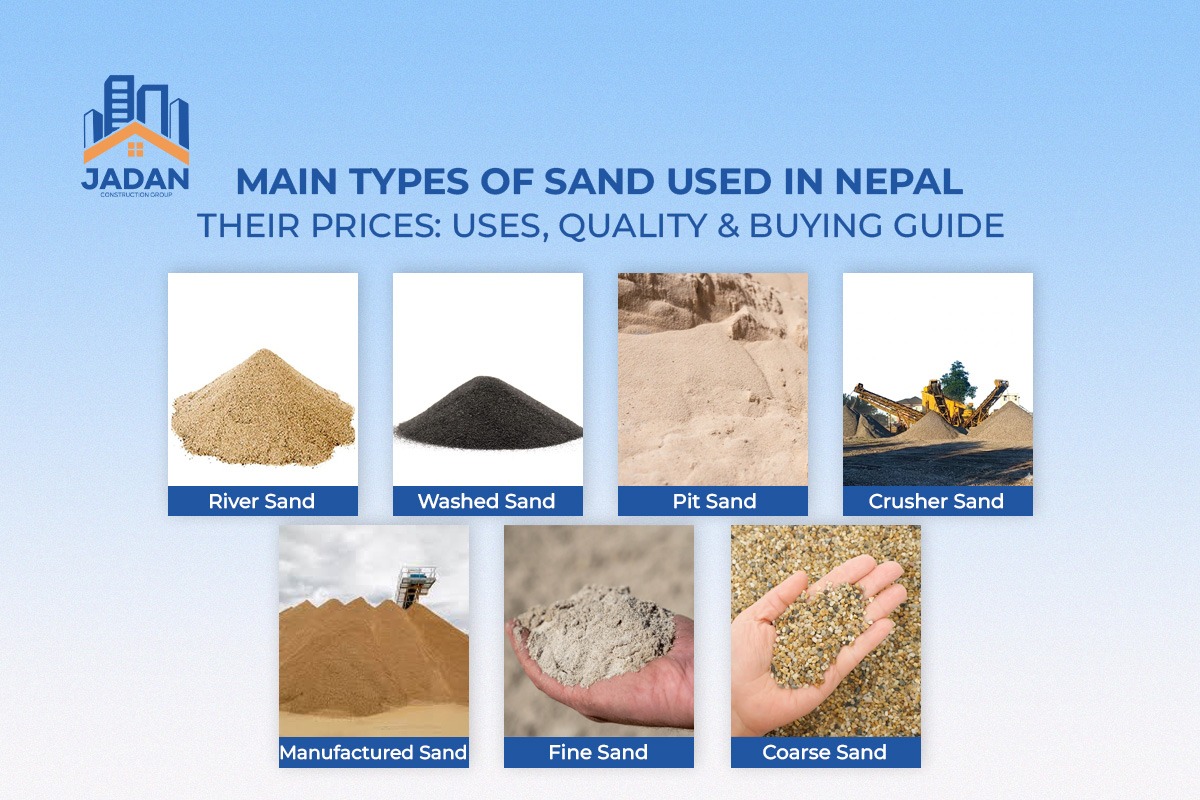
Main Types of Sand Used in Nepal
1. River Sand
River sand is the natural sand obtained from riverbeds, and it happens to be one of the most common construction sands used in Nepal. It takes thousands of years of natural erosion action through water to form the round-shaped particles of the natural sand.
River sand is always the first choice in the construction business in Nepal since it occurs naturally, and it is the sand most people know in Nepal. Properly cleaned river sand serves well in plastering, brickwork mortar, RCC concrete, and floor screed.
Advantages:
- Natural and common in many areas of Nepal
- Good sand for plastering when clean
- Good workability in mortar and concrete mixes
- Natural sand is known by most masons and contractors
- Suitable for RCC, brickwork and plastering depending on the type
Disadvantages:
- It differs in quality depending on the source and season
- It may contain silt, clay, organic matter and extra moisture
- Its price varies due to transport and availability
- Washing may be necessary for unclean river sand
- Over-exploitation is an issue with river sand
Best For: Plastering, brickwork, mortar, RCC concrete, flooring screed and general building construction when quality is ensured.
Quality Observation: If it is plaster, use cleaner and finer sand from the river. For RCC, you have to use appropriately graded sand approved by your structural engineer.
Estimate of Cost: The cost of sand in Nepal in 2025 ranges from NPR 3,750 for every cubic metre to NPR 28,000 for every tipper, in case it is double-washed river sand.
2. Washed Sand / Double-Washed Sand
Washed river sand is the sand from a riverbed that is cleaned with water. The process involves cleaning the sand twice and thus makes the sand cleaner, finer, and of better quality. Washed river sand costs more than normal river sand because it produces better results when used for plastering and finishing work.
Advantages:
- It is much cleaner than normal river sand.
- It provides better plastering and finishing quality.
- Minimizes the chances of cracks due to impurities such as silt or any organic matter.
- Particle sizes are quite uniform.
- It is less wasteful due to its purity and consistency.
Disadvantages:
- It is more expensive than normal river sand.
- It may not be readily available in remote regions of Nepal.
- The quality of washing is different for different suppliers; hence, quality should be checked.
- Transportation costs add to its prices.
Suitable For: High-quality wall plastering, ceiling plastering, interior finishing, and other applications requiring a high-quality surface.
Qualitative Factors: Determine whether the sand available is washed one time or two times. You can check its quality and source by asking the seller.
Pricing Factor: The price for washed sand may be NPR 14,000 per half-truck unit, and that of washed river sand is estimated to be NPR 28,000 per tipper.
3. Pit Sand
Sand from pits is extracted from underground natural resources and is known to be tougher and more coarse than river sand. The angular nature of the sand particles makes it suitable for bonding and is used for foundation concrete, masonry, and other filling works. Pit sand is widely used in Nepal in places where there is a shortage of river sand or where a harsher form of sand is required.
Advantages:
- Angular particles ensure a strong bonding capacity
- Suitable for foundation concrete and structures
- Wide availability across several parts of Nepal
- Could be cheaper than washed river sand
- Good for masonry mortar and backfilling purposes
Disadvantages:
- Not suitable for plastering or finishing purposes
- Varies in quality depending on the excavation area
- Might require washing before use
- Not suited for RCC unless recommended by an engineer
Best For: Foundation concrete, masonry mortar, filling works, etc.
Average Cost Per Tipper: Approximately NPR 25,000 in some Nepal supplier listings.
4. Crushed Stone Sand / Crusher Sand
Crusher Sand is the name given to the crushed rocks, like granite and limestone, to produce a form of sand. The sand is sharp-edged and coarse when compared to river sand. The sand is best for concrete purposes. People have started using crushed stones in Nepal due to their accessibility and efficiency.
Advantages:
- Continuous production in crushed stone plants
- Ensures adequate strength and bonding in concrete
- Reduces dependence on natural river sand
- Sharp edges ensure better interlocking in concrete
- Excellent for RCC concrete upon the engineer's approval
Disadvantages:
- Sharp edges make it harder to use in a concrete mix
- Contains more dust and fine materials if not washed
- Cannot be used for plastering unless processed further
- Quality depends on the nature of the rocks used
Best Suited For: RCC Concrete, Structural Work, Foundation Concrete, and Masonry Mortar for rough surfaces only.
Important Quality Factor: It should be noted that one needs to determine whether the crushed sand is washed because excessive dust particles present in crushed sand that is not washed can make the concrete weak.
Expected Cost: The expected cost of crushed sand in 2025 in Nepal can be NPR 9,500 per tipper.
5. Manufactured Sand / M-Sand
M-Sand is made up of crusher sand, which is specially manufactured by grading and specification of the sand, which is used for construction purposes. The process includes crushing hard rock to produce particles of uniform size and shape. The usage of M-sand has increased in urban areas of Nepal owing to its reliability and controllability compared to natural river sand.
Benefits:
- Guaranteed uniformity of grading and quality
- Contains less clay and silt than natural river sand
- Can be used for RCC concrete and other constructions
- Helps minimize the need for extracting river sand
- Available from reliable suppliers of crushed stone
Drawbacks:
- Higher cost than regular crushed stones
- May not be familiar to some masons in Nepal
- May need a change in the mix design to enhance workability
- Not easily accessible in rural areas of Nepal
Recommended for: RCC concrete work and structural beams, columns, and slabs.
6. Fine Sand
Fine sand consists of particles of smaller sizes compared to coarse sand. They are normally used for plastering, jointing, and surface finishing activities. Finer sand will provide a smoother surface compared to the others. However, fine sand should not be used for RCC concrete mix as it lowers the strength and requires higher water contents in the mix. In Nepal, fine sand is obtained either from rivers or through washing of the river sand.
Pros:
- Smooths the surface finish in walls and ceilings
- Easy to use when plastering the walls
- Used in decorative finishing works
- Provides smoother surface finishes on walls
- Requires less water in construction if clean and well-graded
Cons:
- Should not be used for RCC concrete due to its weakness
- Will require more water when used improperly in the RCC mix
- Harder to identify the silt and clay content of fine sands
- Dirty fine sand leads to cracking of plastered surfaces
- Inconsistent availability in some regions of Nepal
Uses: Plastering walls, ceiling plastering, tile jointing, and decorative surface finishing works.
Quality Tip: The fine sand that will be used in plastering should be clean and free from any form of silt. Otherwise, dirty fine sand will lead to cracking and poor quality plaster even when its particle size is appropriate.
7. Coarse Sand
The coarse sand contains large particles and is suitable for applications where strength and bonding capacity play an important role. Such sand is perfect to be used in RCC concrete, foundations, mortars, and floors where the base needs to be rough. The coarse aggregate used in Nepalese construction mainly comprises river sand and crusher sand from Nepal. The use of coarse aggregate in the preparation of plaster results in a rough surface; it should only be used where coverage is expected.
Pros:
- Improved strength and bonding quality in the concrete and structural mortars
- Perfect for use in RCC slabs, beams, columns, and foundations
- Large-sized particles reduce the water requirement in the mixture
- Can mix perfectly with cement to form concrete with high strengths
Cons:
- Poor quality in terms of being used in plastering projects
- Surface texture tends to be rough, hence an extra finish is required
- Crusher sand contains angular coarse aggregate, reducing workability
- Need proper washing and grading for structural RCC use
Suitability: RCC concrete, foundations, floor screeding, and structural mortars.
Note: The coarse aggregate for RCC must be washed and sized properly. Ineffective coarse sand that contains too much dust and clay weakens the concrete considerably.
Sand Price in Nepal
Sand in Nepal is commonly priced by cubic metter,
|
Type of Sand |
Estimated Price in Nepal |
Best For |
|
River Sand |
Around NPR 3,750 per cubic metre |
Plastering, mortar, general construction |
|
Double-Washed River Sand |
Around NPR 28,000 per tipper |
Premium plastering and cleaner finishing |
|
Pit Sand |
Around NPR 25,000 per tipper |
Foundation, concrete, filling, masonry |
|
Crushed Stone Sand |
Around NPR 9,500 per tipper |
RCC concrete and structural work |
|
Washed Sand |
Around NPR 14,000 per half truck |
Plastering, mortar, finishing |
|
General Construction Sand |
Around NPR 23,000 per unit |
House construction and general site use |
|
Dhalan Baluwa and Crush Gitti Mix |
Around NPR 27,000 per unit |
Concrete-related work |
Important Note: The price of sand in Nepal differs according to the source, region, distance of transportation, tipper or tipper size, quality of washing, fuel rates, seasons, and supplier. It is important to find out the price, quantity, and transportation charges before estimating the total cost of house construction in Nepal.
Which Sand Is Best for Which Construction Work?
|
Construction Work |
Best Sand Option |
Why |
|
RCC Slab, Beam, Column |
Clean river sand, crusher sand, or M-sand |
Needs strength, grading, and clean aggregate |
|
Foundation Concrete |
Coarse sand or crusher sand |
Better bonding and strength when properly graded |
|
Brickwork Mortar |
River sand or clean pit sand |
Good workability and bonding |
|
Wall Plastering |
Washed river sand or fine, clean sand |
Gives a smoother finish |
|
Flooring Screed |
Coarse sand or clean river sand |
Better base and bonding |
|
Tile Bedding |
Fine to medium clean sand |
Easier levelling and finishing |
|
Boundary Wall |
River sand, pit sand, or crusher sand |
Depends on the budget and quality available |
|
Premium Finishing |
Double-washed sand |
Cleaner and smoother surface |
|
Budget Construction |
Locally available clean sand |
Lower transport cost if quality is acceptable |
Important Note: No one type of sand alone ensures that the structure is earthquake-proof in its own right. Construction quality, technique, material, and craftsmanship play an integrated role in determining structural safety. For more insight into structural safety in Nepal, check out our article on earthquake-Resistant houses in Nepal.
River Sand vs Crusher Sand: Which Is Better?
|
Factor |
River Sand |
Crusher Sand |
|
Source |
Natural riverbed |
Crushed hard stone |
|
Particle Shape |
More rounded |
More angular |
|
Workability |
Usually easier to work with |
May need a mix adjustment |
|
Plaster Finish |
Good when fine and clean |
May be rough if unprocessed |
|
RCC Use |
Good if clean and graded |
Good if washed and graded |
|
Availability |
Depends on legal supply and season |
Depends on the crusher plant |
|
Price |
Can be higher in urban areas |
Varies by plant and transport |
|
Quality Risk |
Silt, clay, and organic matter |
Dust, poor grading, excess fines |
For plastering and smooth finishes, washed river sand will be the ideal material to choose. For RCC and structural work, crusher sand/M-sand could also be used successfully, provided it is clean and well-graded.
This is just an option, and what suits best depends on the type of construction you require, the quality and source of sand, as well as your mix design. For more information on sand choice and RCC construction in Nepal, read our blog.
Factors That Affect Sand Price in Nepal
The price of sand in Nepal is not constant and varies greatly due to several practical considerations that may be ignored by home buyers. The kind of sand, whether single-washed or double-washed, and the distance between the origin and the place of use largely influence the price that the homeowner will end up paying for the sand.
Other elements that may determine how expensive or affordable the sand will be include seasonality in supply and demand, fuel prices, tipper size, loading, and off-loading costs, among others. Cheaper sand rates from a non-familiar supplier may prove more expensive than expected because of poor quality issues, such as excessive amounts of silt, wrong grade, wastage, or moisture in the sand that interferes with mixing.
Important considerations affecting sand rates:
- Kind of sand and washing process (single or double washed)
- Location of the source and distance from the construction site
- Tipper capacity and volume of sand
- Costs of fuel and transportation
- Seasonality of demand and supply
- Supplier margin and urgency
- Loading, off-loading, and wastage
How to Check Sand Quality Before Buying
Making an inspection of sand quality before buying in large quantities is another very important step that a property owner can take in protecting their construction budget. Many defects are easy to recognize and detect through tests, even without using laboratory equipment, and thus, making an inspection could save you lots of money. The following are the types of sand checks that one should make:
- It is clean and does not have any clay lumps or mud visible in the sand.
- The sand should be rubbed between the fingers, and it should feel grainy but not sticky.
- Inspect whether the sand contains any kind of organic substance like roots, leaves, or even dark particles.
- Put some sand in a bottle, fill it with water and shake well; after some time, if there are thick silt layers in the bottle, then the sand is highly contaminated with fine impurities.
- Sand that has an unusually bad smell might be contaminated by any form of organic material.
- Check whether the sand is wet.
- Inquire about the place of origin and whether the sand is washed.
- Ensure particle sizes are compatible with the intended work.
- If it is for large-scale work like RCC, then insist on testing in a laboratory.
It is important to conduct an analysis of construction sand since clay, silt, moisture, salt, mica, and organic materials have the potential to reduce the strength of the concrete or mortar and also affect plaster.
Common Mistakes to Avoid When Buying Sand in Nepal
- Picking sands based only on the lowest price without assessing quality
- Using fine plaster sand for RCC concrete without an engineering recommendation
- Using dusty crushed sand without washing before use
- Purchasing sand without doing a silt test by means of a basic bottle test
- Ignoring transport and delivery costs when determining the total price of sand
- Failing to confirm the tipper size and per-unit charge before payment
- Using a mixture of sands haphazardly at the construction site
- Using wet sand without recalculating the water ratio in concrete/mortar
- Storing sand in an uncovered location where it is subject to weather elements
- Procuring from unknown sand sources without assessing the quality and source of sand
- Assuming that all river sand is of superior quality simply because it is river sand
- Assuming that all crushed sand is of poor quality without testing whether washed and sieved
- Failing to consult a structural engineer regarding sand selection for RCC work
How Much Sand Is Needed for House Construction in Nepal?
However, it is not possible to calculate the required sand amount only based on the house's floor area in Nepal. The amount will depend on factors like the size of the building, number of floors, RCC structure, wall types, plaster thickness, mortar ratio, concrete grade, flooring area, and wastage rate.
Two houses of 1,000 sq. ft. and 1,500 sq. ft., respectively, can have different requirements of sand if they differ in terms of structural composition, wall types, and finishing requirements. If you want to learn more about material estimation for home building, check out our guide on the house construction cost in Nepal.
Best Sand for House Construction in Nepal
There can be no one best sand that would suit any construction process for any part of the house. Each construction process requires the appropriate sand depending on which part of the house is undergoing construction.
If one is working on RCC slabs, beams, and columns, then the best type of sand to use will be coarse river sand, washed crusher sand, or M-sand, as recommended by your engineer. In wall plastering and interior works, washed river sand or double-washed fine sand should suffice.
Why Sand Quality Matters in Earthquake-Resistant Construction
Nepal lies in a seismically active region, and the materials used in the building are responsible for its performance during earthquakes. RCC concrete requires the use of good fine aggregate for obtaining adequate strength in beams, columns, and slabs. The mortar requires bonding so that walls can be held together, whereas plaster needs clean sand because poor-quality sand with high silt or clay content will crack prematurely and make the wall less stable due to reduced bond strength in concrete and mortar.
Use of engineer-approved sand with correct mixing ratio and quality control measures is one of the key steps involved in the construction of a safe house. Supervision of site and material testing is just as important as the design itself for ensuring the safety of a house. If you want to know more about the construction of earthquake-resistant houses, read our guide here.
Why Choose Jadan Construction Group for Material Selection?
At Jadan Construction Group, we understand that sand should not be picked based on its price alone. This is because there exists a correlation between the structural demand and the sand, the stage of the construction process, and the longevity of the home. The engineering professionals and site managers within our company will provide you with useful recommendations on sand selection when it comes to RCC construction, plastering, brick making, and finish work, so that we may offer a construction-oriented material recommendation for your benefit.
Whether you are building a brand-new home or undertaking renovation work at your existing home, our company can help you with the selection of materials, the measurement of exact amounts, and saving costs through eliminating the risks of picking unsuitable materials. We operate in all kinds of homes located in Nepal, and we always start each of our projects with a material planning process. Know more about our services or RCC and steel structure services in particular.
Building your new home in Nepal? Contact us now at Jadan Construction Group.
FAQs
What are the main types of sand used in Nepal?
There are several varieties of sand in Nepal, including river sand, washed sand, double-washed sand, pit sand, crushed stone sand, crusher sand, M sand, fine sand, and coarse sand. These sands have their unique uses in various types of constructions, mainly depending on their sizes and grades.
What is the current sand price in Nepal?
Prices of sand are determined based on different factors, such as the kind of sand, location, means of transportation, and the dealer. According to the latest sources of construction in Nepal 2025, river sand costs about NPR 3,750 per m³, pit sand NPR 25,000 per tipper, crushed stone sand NPR 9,500 per tipper, and double-washed river sand NPR 28,000 per tipper.
Which sand is good for plastering in Nepal?
Washed river sand or double-washed fine sand is good for plastering works since it offers better results than unwashed or dirty sand.
Which sand is good for making RCC concrete?
Clean coarse river sand, washed crusher sand, or M sand is the most appropriate kind of sand to be used in RCC concrete, provided that it has been graded accordingly.
Can I use crusher sand for constructing my house?
Yes, we can use crusher sand for house construction if it is clean, properly graded, and dust-free.
Which is better between river sand and crusher sand?
River sand is usually preferred for plastering and smooth finishing works. However, crusher sand is equally usable for RCC and concrete works when washed and graded.
How can I examine sand quality before purchasing?
One should rub the sand between their fingers to check for stickiness. Furthermore, they could fill a bottle with sand, shake it, and observe the silt layer after settling. One must also examine whether there is any clay lump, organic matter, odor, or moisture content in the sand. In the case of large-scale RCC constructions, one can request laboratory sieve analysis or an engineer's approval.
What factors influence the price of sand in Nepal?
The price of sand in Nepal is dependent on the different factors Source location, transport distance, Fuel charges, Seasonal demand, Quality of washing, Tipper vehicle size, and supplier's profit margin.