
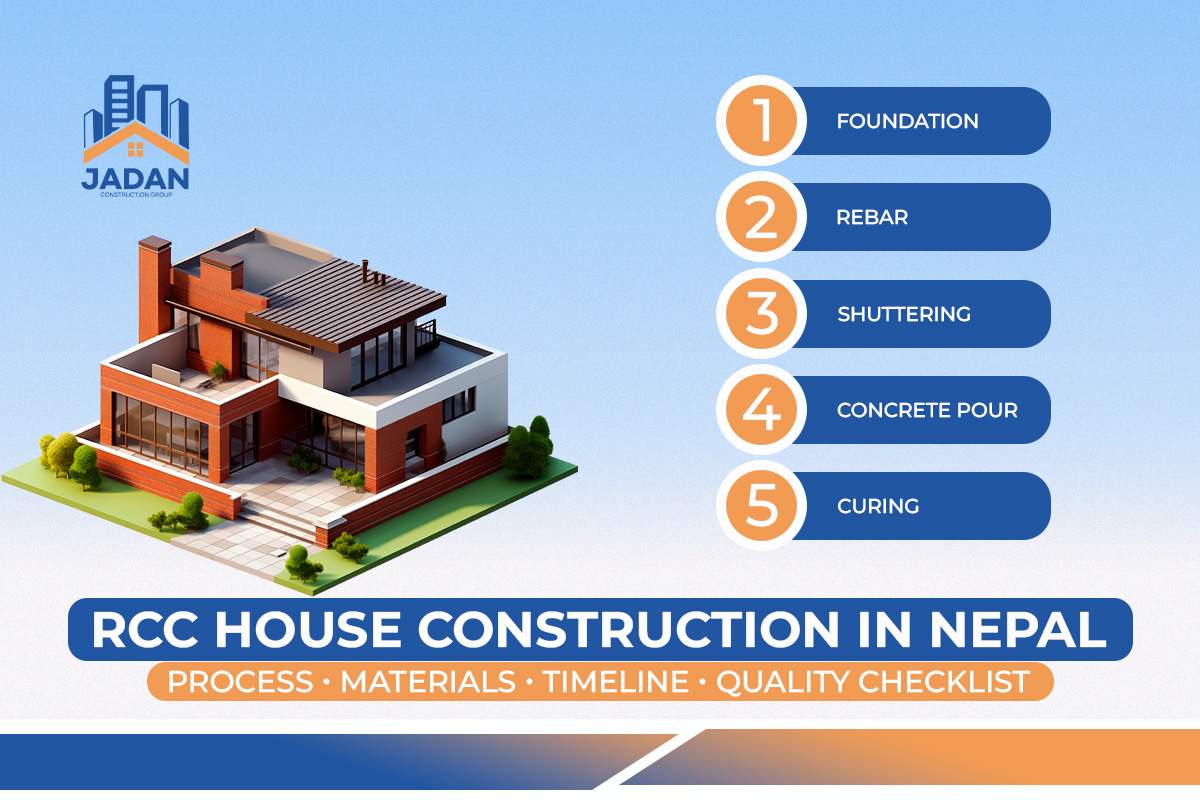
RCC house construction has remained the preferred choice in Nepal to build a home that is both durable and long-lasting. But the fact remains that the issues are not with the method, which is quite effective. Instead, the issues are the mistakes that are made during the process. To ensure that your home continues to be long-lasting, durable, and also budget-friendly, you must understand the entire process of RCC construction.
While the people of Nepal are looking to build homes that are long-lasting, durable, and also budget-friendly, they are unaware of what to check during the process.
What is an RCC House? (Simple Definition)
RCC, which stands for Reinforced Concrete, is a building technique in which concrete and steel are used together to create a robust structural framework. To illustrate this, imagine this: concrete is good at being squeezed but not at being pulled. On the other hand, steel is good at being pulled. Combine these two materials, and they complement each other perfectly.
To illustrate this simply, concrete provides weight and compression resistance, and steel bars, also known as rebar, resist tension. This combination gives rise to a robust structure capable of carrying heavy loads, resisting sideways movements due to earthquakes, and lasting for a long time.
RCC building techniques are responsible for powering various residential and commercial establishments in Nepal.
Why RCC is Common in Nepal (And What It Means for Homeowners)
Several factors make RCC construction particularly suitable for Nepal:
Multi-Storey Capability: RCC frames can accommodate 2-3 storeys for homes and can go higher, thus utilizing scarce space effectively.
Long-Term Durability: RCC infrastructure can endure for 50-100 years with negligible maintenance if properly constructed.
Structural Flexibility: RCC helps create larger room spans and more design freedom than what is possible through traditional load-bearing construction.
Earthquake Resistance: The first thing to note is that an RCC building does not necessarily ensure earthquake resistance, it is also dependent on how it is designed and executed. Thus, an RCC building that is either improperly designed or constructed is just as risky as any other improperly designed building.
However, when engineers who are authorised by the Nepal National Building Code design it, and proper workmanship is applied, RCC buildings do provide good earthquake resistance.
RCC House Construction Process: From Ground to Finish (Step-by-Step)
The entire journey, step by step, from the first site visit, up to handover, can be traced.
1) Site Visit and Requirement Planning
Before digging begins, careful planning must be done. The following are investigated:
- How to access the site, slope, and drainage patterns
- How the sun will hit the space for natural light
- Floor plan needs are based on how you and your family live and work
- Budget targets and project timeline
At Jadan Construction Group, this initial stage involves extensive conversations to establish alignment of your vision with practical reality.
2) Design, Drawings, and Planning
The core issues that this stage involves are:
- Architectural Design: floor plans, elevations, room layouts
- Structural design: loads calculations, foundations, beam/column sizes (need to be done by licensed engineers)
- MEP Planning: Routing for Electrical Wiring, Plumbing Lines, and Sanitary Fixtures
Why start planning early: Making changes after the start of building causes costs to be three to five times higher. All electrical conduits, water lines, and structural details must now be considered.
3) Soil Condition and Foundation Choice
The choice of the foundation depends on two things: soil bearing capacity and the load of the building to be constructed. In Nepal, the most common foundations are:
- Isolated Footings for Individual Columns (Common in Residences)
- Strip foundations for load-bearing walls
- Raft foundation for weak soil or for a heavy structure
- Pile foundations for very weak soil (not common in domestic work)
A Soil Test is highly recommended, especially in areas like filled lands or near rivers.
4) Excavation and PCC Base
Once excavated to the appropriate depth, the Plain Cement Concrete (PCC) layer is constructed. This has two effects:
- Creates a level, clean work surface
- Prevents direct contact between foundation steel and soil
The usual proportion in a mixture of compound concrete is 1:4:8
5) Foundation RCC Work
This begins the structural construction for RCC:
- The steel reinforcement cage is assembled and placed
- Shuttering is put up around the excavation
- The concrete is poured and well compacted
- The quality checks to be performed involve proper spacing of bars, adequate cover blocks, proper alignment, and complete vibration to remove air pockets.
6. Plinth Level + DPC (Moisture Protection
The raised height of the plinth above the ground is taken care of through an approved fill over the plinth, which is approximately 450-600 mm, and provision is also made for a Damp Proof Course that ensures no moisture from the ground enters the wall.
7. Columns + Beams + Slab (RCC Frame Work)
This is, in fact, the turning point of the structure. The steps go like this:
- Secure the steel reinforcement for the columns
- Install column shuttering
- Cast columns in stages for the taller columns
- Place reinforcement for beams and slabs once columns have reached floor level
- Installation of beam and slab shuttering, ensuring it’s strong and braced
- Install electrical conduits and embeds
- Concrete for Beams and Slabs Together
- Vigorously vibrate to achieve proper compaction
Key takeaway: The quality of the slab depends on the quality of shuttering, compaction, and curing. The three factors determine whether the slab remains crack-free or not.
8. Curing: The Step that Protects Strength
The concrete does not dry, it cures with a chemical reaction that requires the presence of water. Well-cured concrete will attain its intended strength, prevent cracks on its surface, and become more durable in the long run.
The optimal solution would be to keep it wet and continuous at least 7-14 days; otherwise, some Nepalese decorators tend to rush the process undesirably and cause cracks at the end.
9. Brick/Block Masonry + Plaster
Once the RCC frame is complete and properly cured:
- Build walls made of bricks or concrete blocks
- Coordinate with rough-in work for electrical and plumbing
- Plaster the interior and exterior walls
Pro tip: Install electrical boxes and plumbing sleeves before masonry.
10. Electrical/Plumbing (MEP) + Testing
MEP work includes:
- Complete electrical wiring
- Plumbing pipe installation
- Roughing in sanitary fixtures
- Exhaustive testing before covering up
With careful planning in this phase, the future nightmare of sawing through slabs and/or walls to connect wires and/or cables will be avoided.
11. Waterproofing, Flooring, and Finishing
Important areas for waterproofing:
- Bathroom: Waterproofing is done before tiles are laid
- Terrace/Floor Roof: Multiple layers of waterproofing material with a slope for drainage
- Balcony: Slope and waterproofing done
Finishing work:
- Flooring
- Painting
- Installation of doors and windows
- Installation of railings
- Fixtures for kitchens and bathrooms
12. Final Inspection and Handover
The final inspection should include:
- Cracks in walls, beams, and slabs
- Slopes for drainage in bathrooms and the terrace
- Waterproofing
- Water test for bathroom before fixtures
- All electrical and plumbing fixtures
- Note down items that need correction
Materials Used in RCC Construction (What Matters for Quality)
Cement
The common types of cement: OPC (Ordinary Portland Cement) and PPC (Portland Pozzolana Cement). In structural elements, OPC is generally preferred over PPC because it attains strength earlier.
Quality check: Select reputable brands and ensure that the cement is not too old, since its strength decreases over time.
Aggreg
- Fine aggregate (sand): Should be clean, sharp, and well graded.
- Coarse aggregate: 20 mm and 10 mm aggregate shall be used for structural concrete.
Key point: Aggregates that are contaminated with clay or other organic materials can have a major weakening effect on concrete.
Water
Potable water alone must be used. Saltwater or contaminated water will reduce strength and sturdiness.
Steel Reinforcement
In Nepal, grades are given by:
- TMT bars (Thermo-Mechanically Treated) for better resistance to earthquakes
- Fe-500 or Fe-500D for structural work
Important Reminder: As essential as the material of the reinforcement used in the structure is the positioning of the reinforcement and sufficient cover with the proper amount of concrete (typically in the range of 25-40 mm).
Workmanship Factors
High-quality materials are necessary but not sufficient in themselves to guarantee the quality of the construction.Equally important
- Consistent Concrete Mix Proportions
- Tight Shuttering with no gaps
- Proper vibration during pouring
- Adequate curing duration
Timeline: How Long Does RCC House Construction Take in Nepal?
Time construction is not the same everywhere; it varies depending on various factors, such as:
- Number of floors to be built
- Degree of complexity involved
- Monsoon season, which can cause significant delays
- Availability of labour
- Speed of approvals and permits
Here is a general idea of what it would take to construct a 2.5-story house:
- Design and approvals: 1-2 months
- Construction of foundation and frame: 3-4 months
- Construction of walls and plastering: 2-3 months
- MEP and finishing work: 2-4 months
- Total time taken: 8-13 months
Please note that finishing work can take as long as construction, depending on how detailed you wish to get and the quality of materials. Do not underestimate this phase of construction.
Want to know more about the costs involved? Check out our Complete Guide for House Construction Cost in Nepal.
RCC Quality Checklist (Client-Friendly On-Site Checks)

This checklist should be followed during site visits:
Reinforcement
- Proper bar spacing no mud, oias per drawings
- Proper binding with tie wires
- Cover blocks placed for maintaining cover
- Lapping of bars at correct locations (i.e., not all bars at one location)
- Bars should be clean (i.e.,l, or excessive rust on bars)
Formwork/Shuttering
- Proper alignment with string lines
- Proper tightness with no gaps
- Proper strength of supports and bracing
- Levels checked before pouring
Concrete Pour
- Proper control of water addition (i.e., water-cement ratio should be properly controlled)
- Proper vibration for removing air voids
- Continuous pouring method should be adopted (i.e., no long gaps between pours)
- Proper joint planning for large slabs
Curing
- Proper curing should begin hours after completion
- Continuous moisture for a period of 7-14 days
- Proper curing of edges and exposed surfaces
Waterproofing & Drainage
- Slope verification for bathrooms and terrace areas (minimum slope of 1:100)
- Water testing should be performed before tiling
- Proper drainage outlets should be provided
Common Mistakes to Avoid
The following common mistakes create most of the problems which occur in RCC construction work.
Rushing the Curing Process: The premature removal of shuttering, together with improper concrete curing methods lead to concrete that develops both weak strength and visible surface cracks.
Poor Shuttering Quality: The improper alignment of shuttering results in both dimensional inaccuracies and uneven surface finishes.
Unplanned Changes During Construction: The introduction of design modifications during construction leads to higher expenses, which also decreases the building's overall structural stability.
Treating MEP as an Afterthought: The structural integrity of a building gets compromised through slab and beam modifications which create paths for electrical and plumbing installations.
Ignoring Waterproofing: The absence of adequate waterproofing measures in bathrooms and terraces and balconies will result in leakage problems that will become apparent within 1 to 2 years.
Neglecting Site Drainage: The absence of appropriate drainage systems during monsoon season leads to foundation settlement which produces lasting structural damage.
When to Choose RCC Construction
Reinforced Concrete Construction is intended for use in the following four construction practices:
- Building permanent residences - great for long-term building or growth.
- Building multi-family, semi-commercial, or multi-use structures - larger than 2 storeys.
- Constructing in earthquake-prone regions, as long as the structure is designed in accordance with the NBC.
- Constructing vertically or urbanly, where the cost of land prohibits horizontal construction.
To learn more about the individual components of RCC construction, please read our article on Essential Elements of RCC Construction.
Why Work With Jadan Construction Group for RCC Construction
At Jadan Construction Group, we utilise a proven three-phase methodology on every RCC project. They are:
Phase 1 – Planning - Requirement analysis; assessment of the site; creation of architectural and structural designs; and preparation of a complete, transparent budget.
Phase 2 - Execution – Construction follows the requirements of the engineering (Structural and Civil) division. Controls for quality are made in accordance with staged work, and each stage is reviewed as it progresses.
Phase 3 - Quality Control - Establish quality through site inspections, verify material for quality, and ensure that all construction meets the guidelines established by the National Building Code regarding earthquake-resistant requirements.
Here is what distinguishes Jadan Construction Group.
- Transparency in Project Management: The project is managed through a stage-based workflow; clients are updated throughout the project.
- Excellence in Site Coordination: The construction of the structure, finishing, and MEP are sequenced at all times.
- Engineering-Led Approach: Every phase of the project is managed by licensed civil engineers.
- CCTV Site Access: Clients living overseas can view their project via CCTV remotely.
In addition to our RCC construction quality, please review the completed projects we have constructed; additionally, you can review our complete range of construction services and how we work with our clients.
Conclusion
If you want to have durable, earthquake-resistant, multi-story houses built in Nepal, there is no better option than using reinforced cement concrete (RCC) for permanent homes. However, the only way to differentiate between a successful and unsuccessful RCC house is through three items:
- Structural design in compliance with the Nepal National Building Code
- Quality materials from reputable suppliers
- Skilled execution of the construction process with attention to the details of the process
To remain informed throughout your construction process, use the quality checklist included in this guide. Remember that the cost of fixing an issue once construction has completed is much greater than that of identifying it during construction.
Do you want to begin designing and building your RCC house with a reputable designer/builder?
Let's Make Your Dream Home a Reality →
Call the Jadan Construction Group today for a free consultation to discuss your project, transparently provide cost estimates for your project and lead you through the entire RCC construction process from design through final handover.
FAQs
-
What is RCC house construction in Nepal?
In Nepal, the construction of RCC houses is a type of house construction involving the use of the reinforced cement concrete technique, where the reinforcement bars are made of steel and they are set into concrete so as to form a rigid structure of the building that is resistant to earthquakes. The technique is the most prevalent in permanent, multi-storey residential constructions in Kathmandu and other Nepalese cities.
-
What are the steps of RCC house construction?
The construction process of RCC house consists of 12 essential steps which are site planning and design, soil test and foundation selection, excavation with PCC base, foundation RCC work, plinth level construction, column frame beam slab structure, curing of 7-14 days, masonry and plastering, installing MEP (electrical/plumbing) installation, waterproofing, final work and final inspection.
-
Which materials are used in RCC construction?
There are five fundamental materials needed in the RCC construction, including cement (OPC or PPC grade), clean aggregates (sand and graded stone chips), steel reinforcement bars (TMT Fe-500 or Fe-500D), clean pure water to be mixed, and good formwork/shuttering. The quality of the material actually used has a direct influence on the strength of the ultimate structure and its durability.
-
How long does it take to build an RCC house in Nepal?
The duration of construction of a typical 2.5-storey RCC house in Nepal is 8-13 months, including design and approvals, 3-4 months constructing the foundation and structural frame, 2-3 months masonry and plastering, 2-4 months installation and finishing of MEP. The different timeline depends on the weather, level of design and level of finishing.
-
What is shuttering/formwork in RCC construction?
Shuttering or formwork is the temporary structure of mould (usually of plywood, steel or aluminium) in which wet concrete is cast into a required shape until sufficient strength is acquired to support itself. Shuttering is done properly so that the beam, column and slab are also correctly dimensioned, aligned and smooth.
-
What foundation is best for an RCC house?
The best type of foundation is based on the bearing capacity of soil and the burden of the building: isolated footings in most housing, RCC on firm soil, strip footings in case of load-bearing walls, raft footings needed when the soil is weak, and pile footings are done when the soil is very poor. A professional soil test identifies the best type of foundation to be used at your site.
-
Is RCC house construction earthquake resistant in Nepal?
Yes, RCC house construction is very earthquake resistant in Nepal in case it is designed by licensed engineers on the basis of Nepal National Building Code (NBC) and it is constructed with proper workmanship of ductile detailing, horizontal tie beam construction, and proper site of reinforcement.
-
What are common mistakes during RCC construction?
The most prevalent sources of mistakes in RCC construction are improper curing (less than 7 days), imperfect or improperly fitted shuttering, unplanned design modification in constructions, cut in structural parts to add electric and plumbing lines, omission of waterproofing in bathrooms and terraces, and neglecting proper site drainage on monsoon seasons. Such errors cause cracks, leaks, structural vulnerability, and expensive damage.
-
How can I check RCC quality during construction?
Control the quality of Check RCC: confirm the appropriate distance of reinforcement between the blocks, ensure that the bars are clean and free of rust or oil, tight shuttering, good alignment, water-cement ratio during concrete pour (no surplus water is added on site), continuous curing (moisture), 7-14 days.
-
When should electrical and plumbing planning be done in RCC houses?
MEP planning should be done at the design stage and before the construction of the RCC starts. Conduits and sleeves should be fitted in the column-beam-slab work and masonry to prevent future cutting of structural elements. The MEP work on RCC members is done by cutting post-construction, which makes the structure weak and against the building codes and is one of the main sources of structural compromise.
-
Should I choose RCC or a panel house?
RCC is best used in permanent structures, multi-storey buildings, and long-term durability (50-100 years life) whereas panel houses can be erected faster (3-4 months compared to 8-13 months) and used at low costs where the building is a single storey or a temporary structure. Comparing the construction of the Panel House and RCC House in detail, use our comparison to find which one is the most appropriate in your case, based on the budget, time frame, and other considerations.