
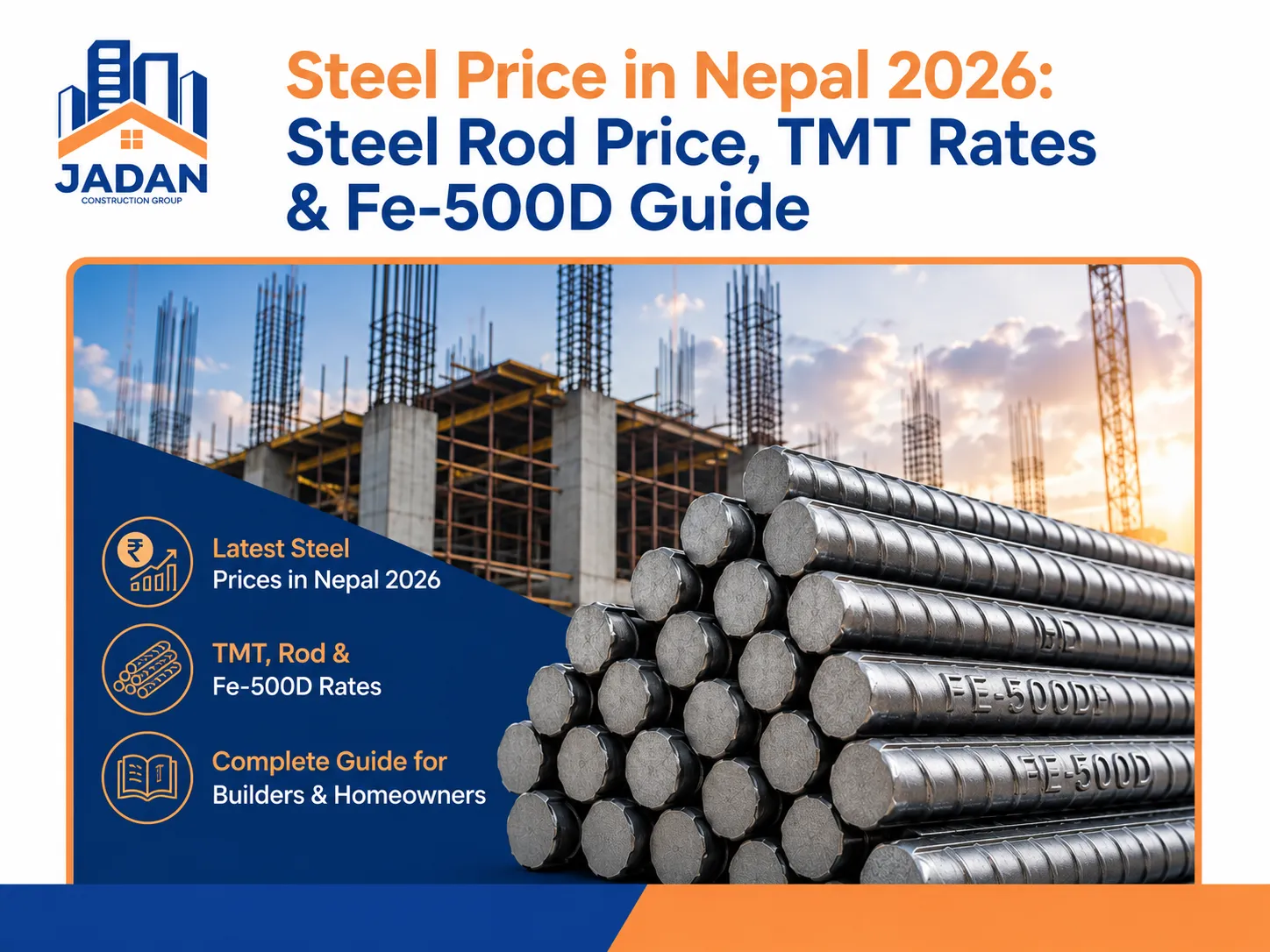
Ask five different steel dealers in Kathmandu what a kilo of TMT bar costs today, and you'll likely get five different answers. That's not anyone being dishonest, it's just how the market works. As of August 2026, the sariya price in Nepal (steel rod, as most people call it locally) runs roughly Rs. 88 to Rs. 120 per kg, and where you land in that range comes down to the brand, the diameter, the grade your engineer specifies, and even which part of the country you're building in.
This guide covers all of it: current rates, how Fe-500 compares to Fe-500D, how much steel your house will actually need, and what to check before a delivery truck unloads on your site. Steel is only one line item though. It sits alongside cement, sand, bricks, and the rest of the materials used in house construction in Nepal, but after cement and labor, it's usually the single biggest cost on the list, which makes it worth getting right.
Steel Price in Nepal 2026: Current Market Rates
Updated: August 2026. TMT bar prices in Nepal currently sit in the Rs. 88 to Rs. 120 per kg range. That's a broad band because steel isn't priced the same way everywhere. Brand, grade, bar diameter, your location, applicable taxes, transport to site, and the dealer you're buying from all move the final number up or down.
A weaker Nepali rupee (it crossed roughly Rs. 144 against the US dollar in early 2026, per Nepal Rastra Bank's exchange rate data) has also pushed costs up industry-wide, since most manufacturers import billets and raw material. As reported by industry sources, including the Federation of Contractors' Associations of Nepal (FCAN), steel prices climbed from around Rs. 72 per kg in 2024 to roughly Rs. 85 to 90 per kg by early 2026, with premium brands now crossing Rs. 100 per kg. Treat this as a directional trend rather than an exact figure, since industry-body reporting is periodic and actual dealer prices vary. None of this means you should expect one fixed number. It means you should treat any quoted price as a starting point and confirm it against your specific order.
Steel Rod Price Per Kg in Nepal
Not every quoted rate means the same thing. Before you compare two prices, check whether each one includes VAT, delivery to your site, loading and unloading, and the dealer's margin. A per-kg rate that excludes tax and transport can look cheaper on paper and end up costing more once everything is added in. Always ask your dealer to break the quote down line by line, and see the brand-wise table further down this page for a fuller picture of where rates currently sit.
Steel Rod Price in Nepal 2026 by Diameter
Bar diameter affects price per kilogram. Smaller bars (8mm, 10mm) generally cost a little more per kg because they pass through more processing at the rolling mill. Very large bars (25mm and above) also carry a premium. The most commonly used sizes for residential construction, 12mm, 16mm, and 20mm, tend to represent the best value on a per-kg basis. As reported by industry sources, here's the general premium pattern relative to 12mm bars, which are typically used as the base price.
|
Bar Diameter |
Typical Use |
Price Premium vs 12mm |
|
8mm |
Stirrups, ties, light slab mesh |
+Rs. 3–5/kg |
|
10mm |
Stirrups, secondary reinforcement |
+Rs. 2–4/kg |
|
12mm |
Slabs, beams, standard columns |
Base price |
|
16mm |
Columns, beams, foundations |
Similar to 12mm |
|
20mm |
Heavy columns, raft foundations |
+Rs. 1–3/kg |
|
25mm and above |
Large foundations, commercial structures |
+Rs. 3–5/kg |
Common Steel Rod Sizes Used in House Construction
Most residential houses in Nepal use a mix of 8mm and 10mm bars for stirrups and secondary reinforcement, and 12mm to 20mm bars for columns, beams, and slabs. Larger diameters come into play for heavier structural elements or bigger spans. None of this is something to decide on-site. The diameter and quantity for each element come from your structural drawings, not from what looks reasonable at the shop.
TMT Bar Price in Nepal by Brand
Brand pricing shifts often enough that any number here is a snapshot, not a promise. The ranges below are as reported by industry sources for the Kathmandu market. Prices in the Terai and hill districts can run Rs. 5 to 10 higher per kg due to transport. Use this table to understand roughly where each brand sits, then confirm the live rate and ask for a written quote before you commit.
|
Brand |
Grade Available |
Price Range (Rs./kg) |
Notes |
|
Jagdamba Steel (Rhino 500D) |
Fe-500D |
90 – 105 |
One of Nepal's largest producers, ISO 9001 certified, widely available |
|
Ambe Steel |
Fe-500, Fe-500D |
90 – 105 |
In business since 1982, with a large nationwide dealer network |
|
Panchakanya Steel |
Fe-500D |
92 – 108 |
Nepal's first NS-certified steel brand, ISO 9001:2008 certified |
|
Premier Steel (NXT 500D) |
Fe-500D |
95 – 112 |
Positioned for higher seismic resistance |
|
Laxmi Steels (Thermex TMT) |
Fe-500D |
92 – 108 |
Produced using German Thermex technology |
|
Hama Steel |
Fe-500D |
88 – 100 |
In business since 1988, among Nepal's earliest NS-certified producers |
|
Siddhi Laxmi Steel |
Fe-500D |
90 – 105 |
One of the few brands producing bars up to 40mm, with a full 8mm to 40mm size range |
Check current supplier quotation for exact, location-specific rates. Ask for the Mill Test Certificate (MTC) on any order, and confirm whether the quoted price includes excise duty, VAT, and delivery, since ex-factory prices from the manufacturer will read lower than retail market rates.
What Causes Steel Prices to Differ Between Brands and Dealers?
- Brand and manufacturing process: Established brands with stronger quality control and certification tend to sit at the higher end.
- Grade: Fe-500D typically costs a little more per kg than Fe-500, usually a 3 to 5 percent difference.
- Diameter: Smaller and very large diameters often carry a premium over mid-range sizes.
- Dealer margin: The same brand can be priced differently by different dealers.
- Location: Rates in hill and far-western districts run higher than in Kathmandu Valley due to transport.
- Taxes and transport: VAT, excise duty, and delivery charges may or may not be included in a quoted rate.
- Order quantity: Bulk orders placed in one batch usually get a better rate than several small purchases.
What Is a TMT Bar and Why Is It Used in RCC Construction?
TMT stands for Thermo-Mechanically Treated. Steel billets are heated to a high temperature, then rapidly cooled with water jets, which hardens the outer layer of the bar while the core stays softer and more ductile. That combination gives TMT bars both strength and the ability to bend under stress rather than snap. In RCC house construction in Nepal, concrete handles compression and steel reinforcement handles tension. Columns, beams, slabs, and foundations all depend on that pairing to work as intended.
TMT bars replaced the older CTD (Cold Twisted Deformed) bars that were common through the 1990s. CTD bars got their strength from being twisted cold, which left them harder but noticeably less ductile and more prone to corrosion, which is the opposite of what you want in an earthquake-prone country. That's largely why CTD has fallen out of use and TMT is now the standard for RCC construction in Nepal.
Fe-500 vs Fe-500D: What Is the Difference?
Fe-500 and Fe-500D are both high-strength TMT grades under IS 1786:2008, the standard most Nepali manufacturers follow. They share the same minimum yield strength. Where they differ is ductility, and that difference matters more than the price gap suggests.
What Does the "D" Mean in Fe-500D?
The "D" stands for ductile. In plain terms, it means the bar can stretch further before it breaks. Picture pulling on a piece of wire: a more ductile wire bends and stretches noticeably before it finally snaps, while a less ductile one gives way more suddenly. That extra stretch, or elongation, is what Fe-500D offers over standard Fe-500.
Fe-500 vs Fe-500D: Technical Comparison
|
Property |
Fe-500 |
Fe-500D |
|
Minimum yield strength |
500 N/mm² |
500 N/mm² |
|
Minimum ultimate tensile strength |
545 N/mm² |
565 N/mm² |
|
Minimum elongation |
12% |
16% |
|
Maximum carbon content |
0.30% |
0.25% |
|
Applicable standard |
Verify these figures against the current IS 1786 standard and your structural engineer's specification before publishing or using them in a client-facing estimate, since standards are periodically revised.
Why Does Ductility Matter in Earthquake-Prone Nepal?
During an earthquake, a structure doesn't just get pushed once. It goes through repeated back-and-forth loading as the ground shakes. A more ductile bar can absorb and redistribute some of that energy by deforming slightly instead of failing outright, which gives a structure a better chance of showing warning signs, like cracking, rather than failing suddenly. This is one reason earthquake-resistant house construction in Nepal puts so much weight on reinforcement detailing and material grade, not just wall thickness or foundation depth. It's worth being precise here: no single material guarantees a building's safety in an earthquake. Ductile reinforcement is one factor among many, alongside structural design, detailing, and construction quality, and the specific requirements for your project should follow the applicable Nepal National Building Codes, including NBC 105 for seismic design, as interpreted by your structural engineer.
Is Fe-500D Better for House Construction?
In most cases, yes, and many engineers in Nepal recommend it as the default choice for residential construction given the country's seismic risk. But "better" here doesn't mean you can swap grades on your own judgment. The right grade for each element of your house depends on your structural design, the applicable code requirements, and your structural engineer's specification. Fe-500D is a strong default recommendation, not a decision to make without professional input.
Which Steel Rod Is Best for House Construction in Nepal?
There's no single "best" brand or grade that applies to every house. What actually determines the right steel for your project is grade (as specified by your engineer), proper certification, a traceable manufacturer, and quantities that match your structural drawings, bar bending schedule (BBS), and bill of quantities (BOQ). A well-known brand bought without checking these details isn't a safer choice than a lesser-known one bought correctly.
Steel for Columns, Beams, Slabs and Foundations
Grade, diameter, spacing, and detailing for columns, beams, slabs, and foundations all come from your structural drawings, and they're not interchangeable between elements. A diameter that works for a beam isn't automatically right for a column, and swapping one grade or diameter for another without engineering approval, even to save money, can affect how the structure performs. If a substitution seems necessary for any reason, it needs to go through your structural engineer first, not through the site supervisor or the steel dealer.
Why Steel Quality Matters for Earthquake-Resistant Houses
Good reinforcement steel is only half the equation. It has to be paired with a structural design that accounts for Nepal's seismic conditions and construction work that follows that design accurately, correct bar placement, proper lap lengths, adequate cover, and careful detailing at joints. Quality steel in a poorly executed structure doesn't deliver the protection it's capable of, and a well-built structure with substandard steel carries its own risks. Both sides need to be right.
Steel Cost and Quantity for House Construction in Nepal
Steel is typically one of the largest single material costs in an RCC house, alongside cement and labour. If you're mapping this against your overall budget, it helps to see how steel fits into the full house construction cost in Nepal picture rather than looking at it in isolation.
How Much Steel Does a House Need?
There's no universal tonnage figure that applies to every house, and any source that gives you one flat number without asking about your project should be treated with caution. The actual quantity depends on your floor area, number of storeys, soil condition, foundation type, structural system, span lengths, and seismic design requirements. Two houses of the same size can need noticeably different amounts of steel depending on these factors. The only reliable way to know your number is through your structural engineer's calculations.
How to Calculate Steel Rod Cost
Once you know your required quantity, the calculation itself is simple:
Total steel cost = required steel quantity (kg) × current price per kg
Worked example (hypothetical numbers only, for illustration): if your engineer's BBS shows a requirement of 4,200 kg of steel for your house structure, and your confirmed supplier rate is Rs. 100 per kg, your estimated steel cost would be 4,200 × 100 = Rs. 420,000. Your actual figures will differ. Use your own BBS quantity and your own confirmed price, not the numbers in this example.
Why a BBS/BOQ Is Better Than a Rule-of-Thumb Estimate
A bar bending schedule (BBS) lists the exact diameter, length, shape, and quantity of every bar in your structure, derived directly from the structural drawings. A bill of quantities (BOQ) then translates that into a priced material list. Both account for wastage, laps, and cutting losses in a way a rough per-square-foot estimate simply can't. Rule-of-thumb numbers are fine for an early, ballpark budget conversation. They're not something to actually order steel against.
Factors Affecting Steel Price in Nepal
Steel prices move for reasons well outside any single dealer's control. Raw material and global market conditions, the exchange rate between the Nepali rupee and the US dollar, import duties on billets, transport costs to your district, seasonal construction demand, and the grade, diameter, and quantity you're ordering all play a part. If you're trying to manage your overall budget rather than just the steel line item, it's worth reading our guide on how to reduce construction cost in Nepal for ways to plan procurement smartly without cutting corners on quality.
Does the Construction Season Affect Steel Prices?
As reported by industry sources, construction activity in Nepal tends to peak between October and February, after the monsoon ends and before the hot pre-monsoon season, and demand (along with prices) tends to run highest during those months. Prices are reported to soften somewhat during the June to August monsoon period when site activity slows. Treat this as a general tendency rather than a guarantee, and check current rates before timing a purchase around it.
How to Check Steel Rod Quality Before Buying
A good price doesn't mean much if the steel itself is questionable. Here's what to check before you accept delivery.
Check Manufacturer Markings and Grade
Genuine TMT bars carry rolled or embossed identification from the manufacturer, along with the grade (Fe-500, Fe-500D, and so on). If a bar is missing this marking, or the markings look painted, stickered, or inconsistent across a bundle, treat that as a red flag and consider rejecting the delivery.
Check Applicable Certification and Test Documentation
Ask for the relevant Nepal Standard (NS) certification for the batch, issued by the Nepal Bureau of Standards and Metrology, and ask for the Mill Test Certificate (MTC) where available, especially on larger orders. The MTC shows the actual elongation percentage and chemical composition tested for that batch, which confirms the steel has actually been tested against the grade it's being sold as.
Check Diameter, Weight and Bar Condition
Every diameter has a standard weight-per-metre range. A 12mm bar should weigh roughly 0.888 kg per metre, and a 16mm bar roughly 1.578 kg per metre. Bars that feel noticeably light for their stated diameter are worth questioning, since an underweight bar usually has a smaller actual cross-section than advertised. Also look over the physical condition of the bars: light surface rust is normal and doesn't affect performance, but heavy, flaky rust with pitting is a sign of poor storage and is worth rejecting.
Buy From a Traceable, Reputable Supplier
Always get a proper invoice that states brand, grade, quantity, and price. A traceable purchase means that if something turns out to be wrong with the batch, you have a documented supplier to hold accountable. Buying loose, unmarked stock to save a little money removes that protection entirely.
Common Mistakes to Avoid When Buying Steel Rods
- Choosing a supplier purely on the lowest price per kg without checking grade or certification.
- Ordering steel before the structural drawings and BBS are finalised.
- Comparing quotes without checking whether tax and transport are included in each.
- Accepting delivery of bars with no visible markings or unclear brand identification.
- Changing a specified diameter or grade on-site without getting engineering approval first.
- Skipping the invoice or test documentation to save time.
Steel Buying Checklist for House Construction in Nepal
A short, practical checklist you can save or screenshot before you place your order and again when the delivery truck shows up.
Before Ordering
- Confirm the required grade with your structural engineer (Fe-500, Fe-500D, or otherwise)
- Confirm diameters and quantities against your BBS/BOQ
- Get quotes from at least two or three suppliers
- Confirm whether the quoted price includes VAT, excise duty, and transport
- Check how long the quoted price is valid for
- Confirm delivery timeline and site access for the delivery vehicle
When Steel Arrives on Site
- Check manufacturer markings and grade on the bars
- Verify diameter matches the order
- Check quantity and weight against the delivery note
- Inspect bar condition for rust, pitting, or bending
- Collect the invoice, MTC, and any other test documentation
Frequently Asked Questions About Steel Price in Nepal
What is the steel price in Nepal in 2026?
As of August 2026, TMT bar prices generally range from Rs. 88 to Rs. 120 per kg depending on brand, grade, diameter, and location. Confirm the current rate with your supplier, since prices shift regularly.
What is the TMT Bar Price in Nepal?
TMT bar prices vary by brand and grade, typically Rs. 88 to Rs. 112 per kg as reported by industry sources for established brands like Jagdamba, Ambe, Panchakanya, Premier, Laxmi, Hama, and Siddhi Laxmi.
What is the Fe-500D Price in Nepal?
Fe-500D generally costs about 3 to 5 percent more per kg than standard Fe-500 from the same brand. Ask your supplier for a current, grade-specific quotation rather than relying on a general figure.
How do I calculate steel requirements for my house?
Steel quantity should come from your structural engineer's BBS and BOQ, not a flat rule-of-thumb figure. Once you have that quantity, multiply it by your confirmed price per kg to estimate cost.
How can I check steel quality before buying?
Check manufacturer markings and grade, ask for NS certification and a Mill Test Certificate, verify diameter and weight, inspect the bars for rust or damage, and buy from a traceable supplier who provides a proper invoice.
Is Fe-500D mandatory in Nepal?
Fe-500D is widely recommended for residential construction in Nepal's seismic zones, but whether it's required depends on your project's structural design and the applicable code and specification. Confirm with your structural engineer rather than assuming it's mandatory in every case.
What's the simplest way to explain the difference between Fe-500 and Fe-500D?
Both have the same yield strength. Fe-500D has a higher minimum elongation (16% vs 12% for Fe-500), meaning it can stretch further before breaking, which is useful under the kind of repeated stress an earthquake creates.
How much steel does a 1000 sq ft house need?
There's no fixed answer. It depends on the number of storeys, soil conditions, structural system, spans, and seismic design. Ask your structural engineer for a project-specific BBS rather than relying on a generic figure.
Does steel price go down during the monsoon season?
As reported by industry sources, some buyers see slightly softer prices during the monsoon months when construction activity slows, but this isn't guaranteed every year. Always check the current rate rather than timing a purchase around a seasonal assumption.
Plan Your House Construction With Jadan Construction Group
Getting the steel grade and quantity right is just one part of building a house that performs the way it's supposed to. It has to work alongside sound structural design, accurate detailing, and construction that actually follows the drawings on site. That's the kind of planning and execution Jadan Construction Group brings to residential projects across Nepal, from structural and RCC work through to budgeting and full project execution.
Need help planning your house construction budget and material requirements? Talk to Jadan Construction Group for a project-specific consultation and estimate.